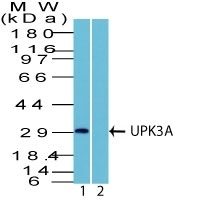
UPK3A (Uroplakin 3A) (Rabbit PAb), CF488A conjugate, 0.1mg/mL
antibody-protein-poliovirus
Description
Uroplakin-3A (UPK3A) is a component of the asymmetric unit membrane (AUM) . It is a highly specialized bio-membrane made by terminally differentiated urothelial cells. The protein may play an important role in AUM-cytoskeleton interaction in terminally differentiated urothelial cells. UPK3A also contributes to the formation of urothelial glycocalyx, which may play an important role in preventing bacterial adherence through FimH bacterial protein binding leading to bladder infection. UPK3A has been shown as a helpful marker for the detection of bladder cancer. Primary antibodies are available purified, or with a selection of fluorescent CF® Dyes and other labels. CF® Dyes offer exceptional brightness and photostability. Note: Conjugates of blue fluorescent dyes like CF®405S and CF®405M are not recommended for detecting low abundance targets, because blue dyes have lower fluorescence and can give higher non-specific background than other dye colors.
Specifications
Description
Uroplakin-3A (UPK3A) is a component of the asymmetric unit membrane (AUM) . It is a highly specialized bio-membrane made by terminally differentiated urothelial cells. The protein may play an important role in AUM-cytoskeleton interaction in terminally differentiated urothelial cells. UPK3A also contributes to the formation of urothelial glycocalyx, which may play an important role in preventing bacterial adherence through FimH bacterial protein binding leading to bladder infection. UPK3A has been shown as a helpful marker for the detection of bladder cancer. Primary antibodies are available purified, or with a selection of fluorescent CF® Dyes and other labels. CF® Dyes offer exceptional brightness and photostability. Note: Conjugates of blue fluorescent dyes like CF®405S and CF®405M are not recommended for detecting low abundance targets, because blue dyes have lower fluorescence and can give higher non-specific background than other dye colors.